How Old Do You Have to Be to Donate Eggs?
You have probably seen 18 in one place and 21 to 34 in another, and wondered which is right. Both are, for different reasons. One is the law. The other is what fertility programs actually accept.
Here is where each number comes from, and where you fall.
The short answer
You must be of legal age in your state to donate eggs, which is 18 in most of the United States and 19 in a few. Separately, the American Society for Reproductive Medicine recommends that egg donors be preferably between the ages of 21 and 34, and most programs follow that guidance.
Blossom Fertility accepts donors aged 21 to 34. If you fall outside that range, it is still worth asking, because ranges differ between programs.
Why programs set the minimum at 21, not 18
The age of majority and the age a fertility program is comfortable working with are not the same thing. ASRM’s preferred minimum of 21 reflects a few practical realities.
- Egg donation is a multi-step medical process involving injections, repeated monitoring and a procedure under sedation. Programs want donors with enough life experience to weigh that decision fully.
- Medical follow-up matters. Many people aged 18 to 20 are in a period of transition, and programs prefer donors who are straightforward to stay in contact with afterwards.
- Screening protocols and professional guidance are built around donors in their early twenties and above.
ASRM does allow donors under 21 in some circumstances, with a psychological evaluation by a qualified mental health professional and a decision made case by case. In practice, most programs, including Blossom Fertility, set a firm minimum at 21.
Why there is an upper limit too
Egg quality and quantity decline gradually with age, and outcomes for intended parents track that decline. ASRM’s preferred range therefore tops out at 34.
Above 34, ASRM does not treat donation as off-limits. It requires that the donor’s age be disclosed to the intended parents as part of informed consent, so they can make the decision with that information in hand. Many programs simply set their cut-off at or below 34 rather than manage that disclosure.
None of this is a judgement on anyone’s health at a given age. It reflects what the evidence shows about outcomes and what intended parents are consenting to.
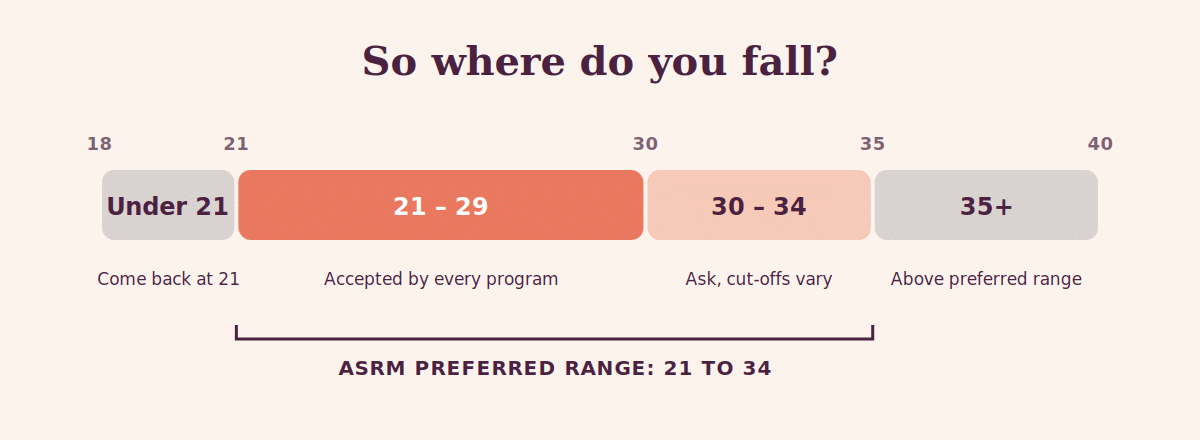
So where do you fall?
- Under 21. Not eligible at Blossom Fertility. Some programs consider applicants under 21 with an additional psychological evaluation, but it is uncommon. This is a policy threshold, not an assessment of you.
- 21 to 29. Squarely within the range every program accepts.
- 30 to 34. Within ASRM’s preferred range. Some programs narrow their own cut-off below this, so it is worth asking rather than assuming.
- 35 and above. Above ASRM’s preferred range. Most programs set their cut-off before this point.
If you are close to a cut-off in either direction, ask directly. Ranges vary enough between programs that a no from one is not a no everywhere.
NOT SURE WHERE YOU FIT?
Close to an Age Cut-Off? Just Ask.
Age is only the first check. Programs also look at health, BMI and family history, and the ranges differ from one program to the next. See the full list of requirements, or ask a coordinator directly where you stand.
If you are under 21 right now
You are not out of the running, you are early. Most donors apply between 21 and 29, so if you are 19 or 20 the practical answer is to come back when you reach 21. Nothing about applying later puts you at a disadvantage.
In the meantime, the eligibility criteria are worth reading, because some of them take time to meet.
Age, family timing and the conversation at home
For many donors from Indian, South Asian, Middle Eastern and other close-knit communities, the 21 to 34 window overlaps with the years when family expectations about marriage and children are most present. That makes the age question less about eligibility and more about timing.
Two things worth knowing. Donating does not reduce your own chances of having children later, and your participation stays confidential, so the decision about who to tell remains yours. If you would like to talk it through with a parent or a trusted figure first, we will hold your application open without pressure for as long as that takes.
Our Indian and East Indian egg donor program and our other heritage programs cover this in more detail.
Age is one factor, not the only one
Meeting the age range gets you in the door, but it is not the only requirement. Programs also screen for overall health, BMI within a defined range, no significant hereditary conditions and non-smoking status, among others. Our full egg donor qualifications page sets out the complete list.
Frequently Asked Questions
What is the youngest age you can donate eggs?
You must be of legal age in your state, which is 18 in most of the US. In practice most programs, including Blossom Fertility, set their minimum at 21, in line with ASRM guidance.
Can I donate if I am 19 or 20?
Not at Blossom Fertility. ASRM allows programs to consider donors under 21 with a psychological evaluation, but it is uncommon. This is a policy threshold, not an assessment of your health.
Is there an age where you are too old to donate?
ASRM recommends a preferred upper age of 34. Above that, the guidance calls for the donor’s age to be disclosed to intended parents rather than ruling donation out, and most programs set their cut-off at or below 34.
Does age affect how much I get paid?
No. Compensation at Blossom Fertility reflects your time, the medical process and the responsibility involved. It is the same for every donor regardless of age or background.
Does donating at an older age affect my own fertility later?
Preliminary research indicates that egg donation does not reduce a donor’s ovarian reserve at any age within the eligible range. ASRM notes that long-term follow-up data remain limited and recommends no more than six donation cycles for any one donor. Your physician will discuss your individual situation during screening.
If I am 34 or 35, is it worth applying?
Yes, ask. Programs set their own cut-offs within and around ASRM’s preferred range, so the answer differs between them. A no from one program is not a no everywhere, and egg donation is not the only way to help a family.
I am past the age range for egg donation. Are there other options?
Possibly. If you have carried a healthy pregnancy to term, you may be eligible to become a gestational carrier instead, and the age ranges for gestational carriers run higher than they do for egg donors. The requirements are different, so falling outside one does not rule out the other. Get in touch, and we will tell you honestly whether either pathway fits, or see our surrogate qualifications for the full criteria.
The Bottomline
The quickest way to know where you stand is to ask. Blossom Fertility offers a free, confidential eligibility check, with no obligation either way.
Wondering If Your Age Qualifies? Start With a Conversation.
Whether you are 21 or close to a cut-off, a quick check will tell you more than guessing. Blossom Fertility offers a free, confidential eligibility check with no obligation, and a dedicated coordinator will answer your questions honestly from the first message to the end of your cycle.